Insights · Cogeneration
What cogeneration is and when it fits industry
A plant that buys electricity from the grid and burns gas in a boiler pays twice for energy. Cogeneration produces electricity and useful heat from a single fuel. This article explains how it works, which types exist, what the law says and which plants benefit most.
Originally published on · Updated on
What cogeneration is
It is the simultaneous generation of electricity and useful heat from a single fuel source. In a conventional power plant, process heat is released to the atmosphere; a cogeneration system captures it and uses it in the plant. That is why overall efficiency can reach up to 85%.
How it works
A gas engine (or a turbine, depending on scale) generates the plant’s electricity. Heat from the exhaust gases and the engine’s cooling water is recovered with heat exchangers and recovery boilers and used for:
- Process steam (food, pharma, chemicals, paper).
- Hot water for processes or space heating.
- Chilled water through absorption chillers, which makes it trigeneration.
- Drying, pasteurization, sterilization and other thermal uses.
The plant can run grid-connected, with the grid as backup, or islanded. It can be combined with battery storage (BESS) to absorb load swings and improve availability.
Types of systems
Gas engine
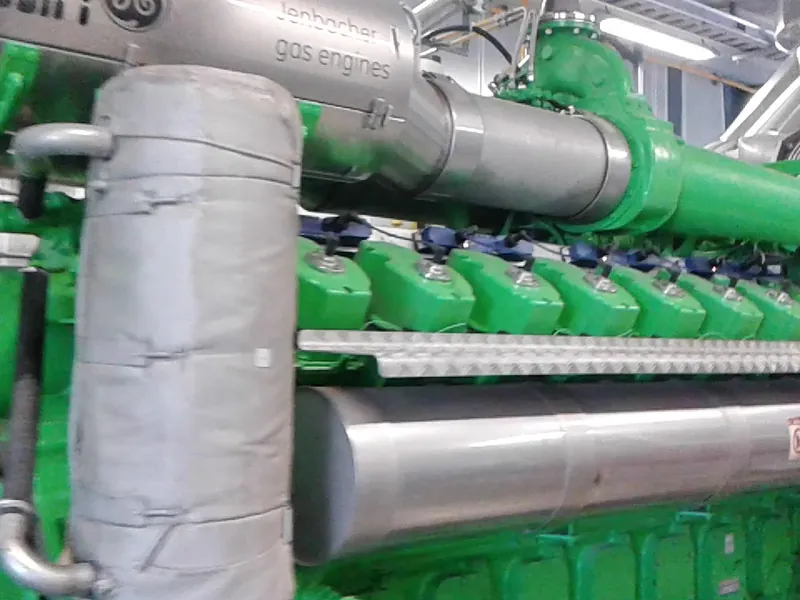
The most widely used technology in industry. It is modular: several units add up to the capacity the operation needs and allow one to be serviced while the others run. GIS Power works with INNIO Jenbacher and Guascor, commercial partners with brand-use authorization.
Gas turbine
For large facilities with high steam demand. Lower electrical efficiency than an engine but more high-pressure steam. Used in petrochemicals, cement and paper.
Steam turbine
Added to plants that already have boilers: high-pressure steam drives a turbine and low-pressure steam returns to the process.
How much it can save
It depends on the electric and thermal profile. Where there is heat to use, savings against CFE can reach up to 40–50%. The group’s documented case is Alestra Green Data Center: 4.2 MW of cogeneration with absorption chillers and 45% energy-cost savings.
Other group cogeneration projects in Mexico:
- Cuadritos Industrial Park, Celaya: 4.8 MW with process steam.
- Logistik Industrial Park, San Luis Potosí: 9.5 MW on biogas.
- Pronal, Villa de Reyes: 10 MW.
In total, the group has developed 56+ MW of cogeneration in Mexico.
What the Electricity Sector Law says
Mexico’s Electricity Sector Law (Official Gazette, March 18, 2025) recognizes three generation figures: distributed generation, self-supply and generation for the wholesale market (art. 17). Permits are granted by the National Energy Commission (CNE), and a generation permit may include the cogeneration modality (art. 18).
- Cogeneration exists when electricity is produced together with steam or other secondary thermal energy, when unused process heat is used to generate power, or when fuels produced in the process itself are used (art. 41).
- Permit capacity is limited to the power obtainable from the unused thermal energy of the associated process (art. 42).
- Cogenerated energy has must-run dispatch, limited to the energy derived from the process’s thermal needs (art. 43).
- Self-supply is generation of 0.7 MW or more for one’s own needs; grid-connected plants between 0.7 and 20 MW may follow a simplified procedure (art. 30). Below 0.7 MW, the plant is an exempt generator and needs no permit (art. 19).
More detail in The Electricity Sector Law: what changes for industry and permitting and development.
Which plants benefit most
- Continuous electric demand.
- Two- or three-shift operation.
- Need for process heat (steam, hot water) or cooling.
- Access to natural gas, or on-site biogas.
- A long horizon at the same site.
Sectors with the most potential: manufacturing, food and beverages, pharma, paper, hospitals, hotels, data centers and industrial parks.
When it is not a fit
- No thermal demand: cogeneration loses its edge over other sources.
- Single-shift operation or very variable load.
- No gas at the site and no on-site biogas.
GIS Power’s signature is solar with storage as primary power; cogeneration comes in where heat justifies it. See hybrid and BESS.
How it is implemented
- Energy assessment: electric and thermal consumption profile.
- Basic engineering: sizing, equipment selection, savings and payback estimate.
- Detailed engineering and permits: construction design and filings with CNE and, where applicable, CENACE and CFE.
- Construction: civil works, erection and connections.
- Commissioning: performance tests and staff training.
- Operations and maintenance: continuous service under contract.
The stages and their deliverables are in project lifecycle.
Frequently asked questions
Can I stay connected to CFE?
Yes. In grid-connected self-supply the grid stays as backup during maintenance. If the plant exports surplus, it can only sell it to the state-owned utility, with a valid permit and interconnection contract (art. 32).
What fuel does it use?
Usually natural gas. It can also run on biogas, as at Logistik; see biogas.
How much space does it need?
It depends on the number of engines, the heat recovery and whether it sits in an engine house or a container. It is defined in basic engineering.
Sources
- Electricity Sector Law, Official Gazette (DOF), March 18, 2025, arts. 17, 18, 19, 30, 32, 41, 42 and 43.
- Group project history (Alestra, Cuadritos, Logistik, Pronal).
Is your plant a cogeneration candidate?
Demand, shifts and thermal load: with that we tell you whether it fits and at what scale.
By sending you accept our privacy notice.