
A · Large-scale cogeneration · Trigeneration
Engine heat, turned into chilled water
Trigeneration generates power on site and uses the engine’s heat for two things: useful heat and, with absorption chillers, chilled water for air conditioning or the process. At Alestra Green Data Center in Querétaro, that is how 100% of the data center’s power and chilled water was supplied.
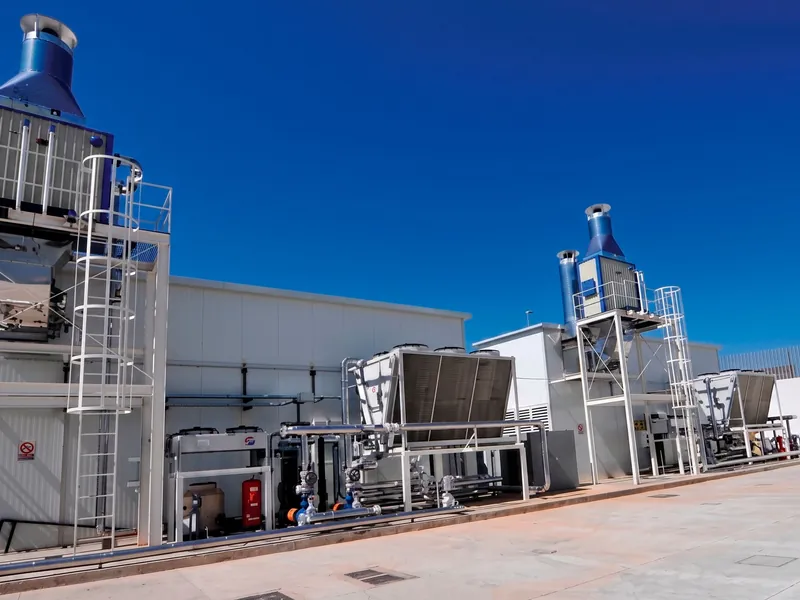
What trigeneration is
Power, heat and cooling from a single fuelA building with a high cooling load, such as a data center, a hospital or a shopping center, spends much of its power on electric chillers. Trigeneration changes that equation: the engine generates the power, and its heat drives absorption chillers that produce chilled water without a compressor’s power draw.
The result is lower power demand for cooling and fuller use of the fuel. It works best where the cooling load is steady all year round, as in a data center.
When it is not a fit
- If the cooling load is seasonal or small: the absorption chillers would sit idle much of the year.
- If there is no natural gas at the site with enough pressure and capacity.
- If the building does not run most of the day: the system performs when it runs continuously.
How it works
From the engine to chilled water
Step by stepGeneration
Gas engines generate the facility’s power on site.
Heat recovery
Heat from the exhaust gases and engine cooling is recovered as hot water.
Absorption
Absorption chillers use that heat to produce chilled water.
Distribution
Chilled water goes to air conditioning or the process; power goes to the load.
Backup
Electric chillers and the grid remain as the plant’s backup.
Operation
24/7 operation and maintenance with contracted availability.
Reference: Alestra Green Data Center
Querétaro · 2013–2014 · Full design and construction (EPC)4.2MW
Capacity
2 GE Jenbacher engines
2 × 350t
Absorption chillers
Chilled water from engine heat
100%
On site
Of the data center’s power and chilled water
45%
Savings
In energy cost, documented
The group designed, built and commissioned a 35,000 m² modular data center for Alestra, together with its power plant. The two GE Jenbacher engines generate the power, and their heat drives two 350-ton absorption chillers that produce the data center’s chilled water.
The project received the “Innovation in the Mega Data Center” award from DC Dynamics on October 1, 2014. It is the first data center with cogeneration in Mexico.
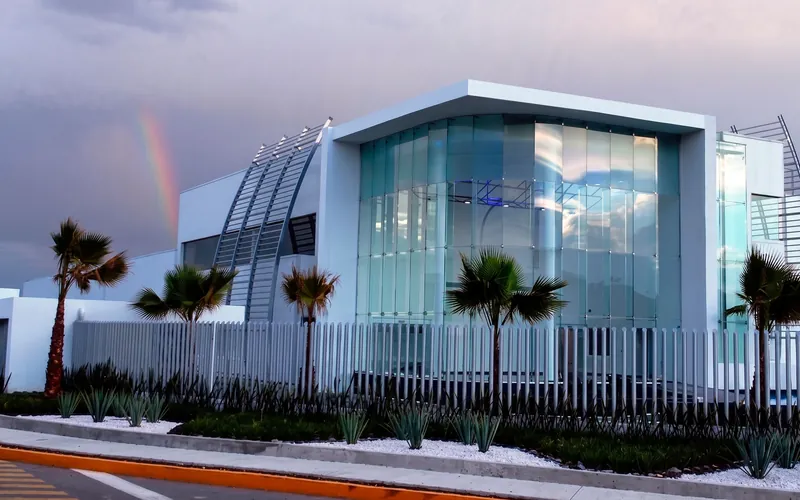
Before Alestra: PwC, 1999
Cogeneration and absorption in a corporate buildingPwC’s national headquarters in Mexico City, a USD 35 M project in 1999, was built with cogeneration and absorption chillers. It is part of the group’s critical power track record, which begins in 1983 with ESI in Tampa.
Where it is used
- Data centers, where cooling is constant all year.
- Hospitals and corporate buildings with continuous air conditioning.
- Industrial processes that need cooling, such as food and beverage.
Frequently asked questions
Does an absorption chiller replace electric chillers?
It covers the base cooling load with engine heat. Electric chillers usually remain as backup and for peaks, especially in critical facilities.
How much does it save?
It depends on the cooling load, the gas price and the power tariff. At Alestra, the documented savings were 45% of the energy cost. Feasibility calculates it for your site.
Can it be combined with solar?
Yes. In GIS Power’s approach, solar with storage (BESS) is primary power, and trigeneration comes in where the cooling load justifies it, as in Green Data Center.
Let’s assess your site
Location, power demand, cooling load and available gas: that is where we start.
By sending you accept our privacy notice.