

Critical power
For facilities that cannot stop
- Track record
- 1983Power for mission-critical facilities since that year
- Facilities
- 13data centers and critical facilities designed and built
- Floor area
- 180,000+ m²of mission-critical facilities
- Countries
- 3Mexico, the United States and Brazil
Critical power
Power that does not go down
A data center, an airport or a telephone exchange cannot lose power for a second. The group designs, builds and operates the infrastructure that prevents it: redundancy, UPS, battery storage (BESS), on-site generation and operations with contractual availability. It has done so since 1983, in Mexico, the United States and Brazil.
What critical power means
Power as part of business availabilityIn a mission-critical facility the question is not what a kWh costs, but what happens when a component fails. The answer is designed in advance: every piece of equipment that can fail has another one ready to take the load, and the transfer happens without the load noticing.
GIS Power applies that approach to the site’s entire power system. Primary power can be solar with BESS, the grid or on-site generation; the continuity layer sits on top of it: UPS, backup generation, redundant distribution and an operations team accountable for availability.
This is the line of work the group was born with. ESI started in Tampa in 1983 building data centers for telecom and technology companies, and that experience is the basis of Green Data Center by GIS Power.
When it is not a fit
- When operations can tolerate short outages and the site’s grid is stable: a basic backup plant may be enough.
- When all you need is to replace a UPS or a battery bank: that is maintenance work, not a power project.
- When no one will sign a long-term operations contract: availability is sustained by operating, not just by building.
What it includes
Each layer has its job
From primary power to 24/7 operationsRedundancy
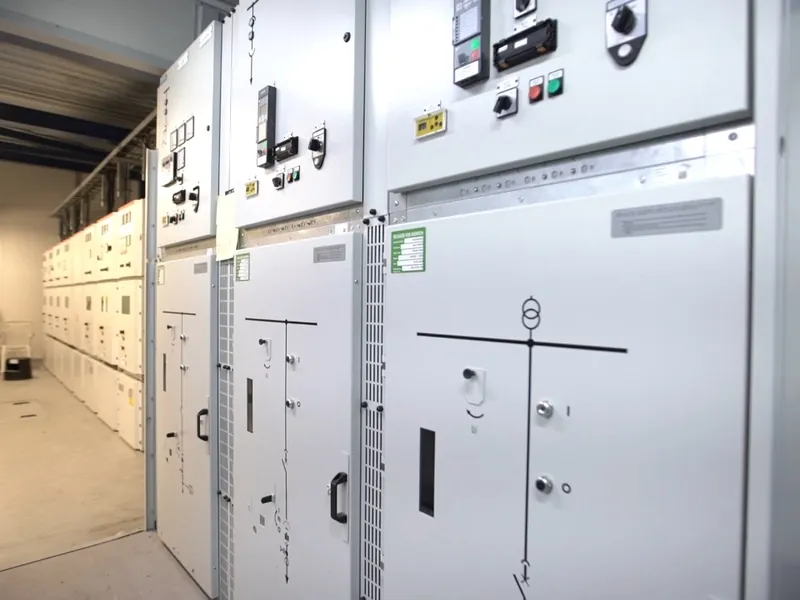
N+1 and N+N architectures, dual utility feeds and redundant distribution, to the availability level the facility requires.
UPS
Uninterruptible power systems sized for the critical load and for the time it takes backup generation to come online.
Battery storage (BESS)
Batteries that carry the load through transients, shift solar energy into the night and cut engine hours.
On-site generation
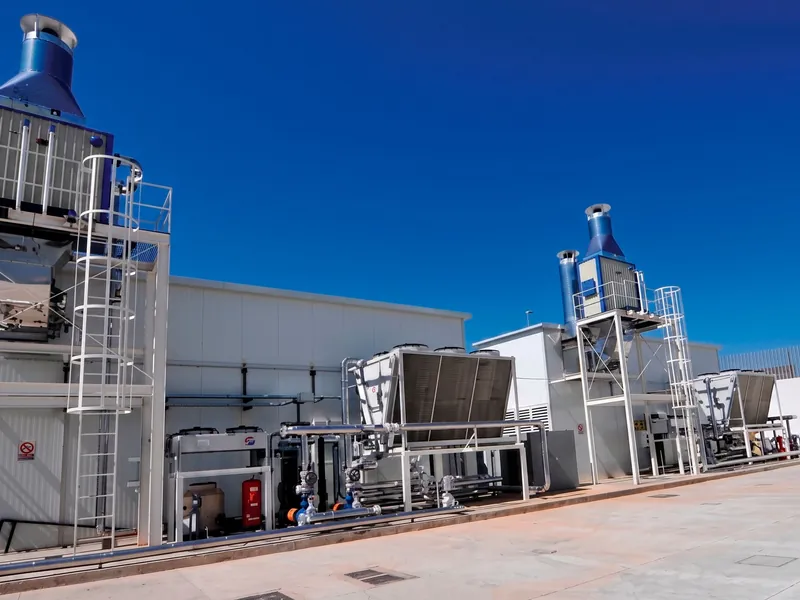
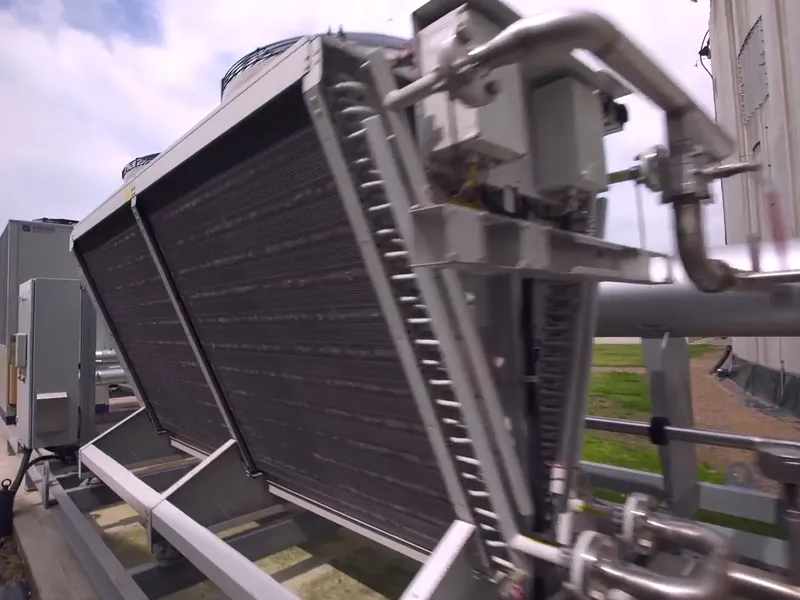
Solar with BESS as primary power and, where there is thermal demand, cogeneration with absorption-chilled water.
Backup generation
Paralleled plants with seamless transfer. Emergency-only generation needs no permit (Electricity Sector Law, art. 19).
O&M with contractual availability
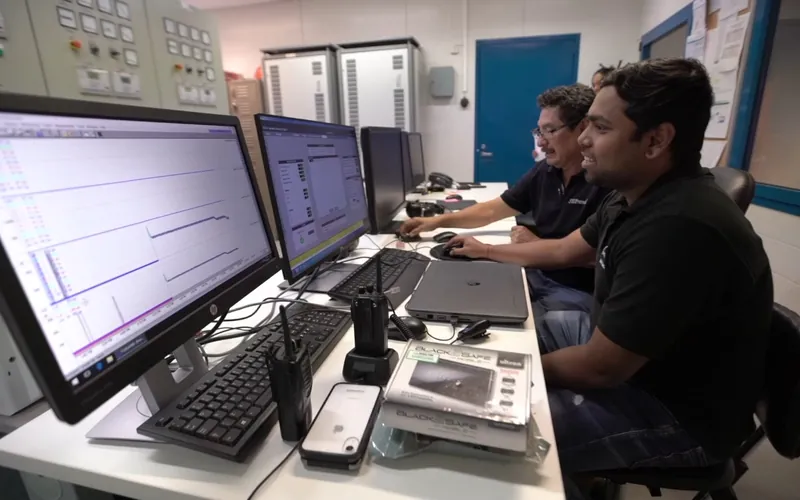
Operations and maintenance with availability indicators written into the contract, for the life of the project.
How continuity is designed
Examples from the group’s track recordEvery mission-critical project the group has delivered was designed for a specific availability level. Some examples from PMI’s project history:
- GTE Data Services, Mexico City (1998): N+1 design with two 2 MW diesel generators and two 750 kVA UPS units. Ten months from design to completion.
- DIGEX, Maryland (1999): N+1 and N+N design with three 2 MW diesel generators and four 750 kVA UPS units.
- Mexico City Airport Terminal 2 (2006): Tier 4 data center with dual utility feeds and 200% redundant UPS power.
- Telemar, Rio de Janeiro (2001–2002): power room with 6 MW of redundant cogeneration and a separate operations and maintenance contract.
- AT&T, Jacksonville (1998): generator and switchgear replacement for a 24/7 main data center, with no service interruption.
What is defined up front
- The critical load and its expected growth.
- The redundancy level (N+1, N+N, dual feeds).
- UPS and BESS autonomy.
- Primary power: grid, solar with BESS or on-site generation.
- The availability indicators in the operations contract.
Mission-critical track record
ESI, PMI and GIS Power, since 1983| Project | Location | Year | Scope |
|---|---|---|---|
| GTE Data Services Technology Center, phases I–III | Tampa, FL | 1987–1994 | Technology center with computer rooms: design, program management and construction |
| GTE Data Services | Fort Wayne, IN | 1992–1993 | Data megacenter, design-build |
| GTE Data Services | Sacramento, CA | 1993–1994 | Data megacenter, design-build |
| Telmex | Mexico City | 1994 | Switching facility: redundant power systems and paralleled generation |
| GTE Data Services Mexico | Mexico City | 1998 | N+1 data center, design-build |
| AT&T Solutions | Jacksonville, FL | 1998 | Generators and switchgear for a 24/7 data center, with no interruption |
| Nielsen Media Research | Dunedin, FL | 1999 | Data center, paralleled generation and redundant UPS |
| DIGEX Web Farm | Maryland | 1999 | N+1 and N+N web farm |
| PwC, national headquarters | Mexico City | 1999 | Redundant power and cooling with cogeneration and absorption chillers |
| Telemar, phases I and II | Rio de Janeiro, Brazil | 2001–2002 | Data centers with 6 MW of redundant cogeneration |
| TNEXT Data Center | Rio de Janeiro, Brazil | 2002 | Data center and web farm, design-build |
| TSA, 72 airports | United States | 2002–2003 | High-availability power systems for security screening equipment |
| Mexico City Airport Terminal 2 | Mexico City | 2006 | Tier 4 data center, design-build |
| Alestra Green Data Center | Querétaro, Mexico | 2013–2014 | Modular data center with 4.2 MW of cogeneration |
Source: PMI International project history (ESI, PMI and PME) and GIS Power company profile.
Four decades of continuous work: mission-critical first, power plants next
Investment in each group project by delivery year. Below, plants and studies with no published amount.
Takeaway
The group has never stopped building: from 1993 to 2006, data centers and critical facilities in the US, Brazil and Mexico; since 2009, on-site power plants.
Alestra (2014) joins both stories: a data center with its own generation. It is the direct precedent of Green Data Center.
PMI International and GIS Power track records. The 13 mission-critical facilities total USD 317 M; other projects are not counted in that figure. BBVA Lago Esmeralda: design of a USD 250 M project, not group-executed investment.
Frequently asked questions
Does backup generation need a permit?
No, if it is only for your own use during emergencies or supply interruptions: the Electricity Sector Law exempts it from permitting regardless of capacity (art. 19). If the plant will run continuously and is 0.7 MW or larger, it does need a permit.
Can solar and BESS be combined with a mission-critical facility?
Yes. Solar with BESS can be the primary power, while the continuity layer (UPS, backup and redundant distribution) is designed separately, to its own criteria. That is the approach of Green Data Center by GIS Power.
Do you work on facilities that are already running?
Yes. Much of the group’s track record consists of expansions and replacements at sites that could not stop, such as AT&T’s data center in Jacksonville or the GTE expansions.
Who operates the facility afterwards?
GIS Power can operate and maintain it with availability indicators in the contract, or hand it over to the client’s team with training and procedures.
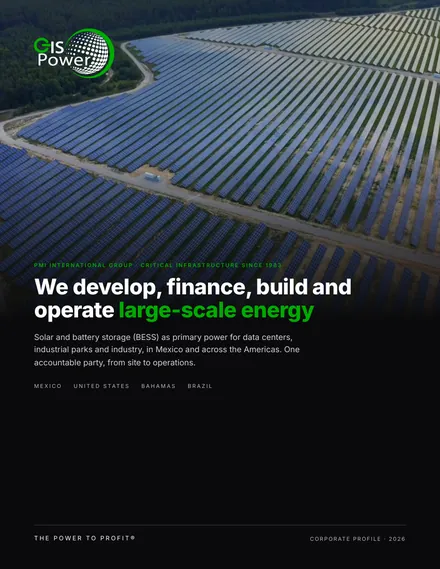
Download
Corporate profile
Who we are, what we do, how to contract and the group's projects, in 4 pages to share with your team.
Download the profile (PDF, 1 MB)Let’s talk about your critical facility
Facility type, critical load and redundancy level: that is where we start.
By sending you accept our privacy notice.