

Insights · Data centers
Data center power in Querétaro: how not to wait for the grid
In a data center, the date that rules the schedule is not the civil works or the servers: it is power. If interconnection arrives after the IT load, the building waits. These are the routes a data center director has to avoid depending on that timeline, and what to ask of a feasibility study before deciding.
By P.M. Jonathan Luna R., Chief Operating Officer · Published on
Why power is the bottleneck
A data center is built hall by hall and filled client by client. Civil works, cooling and IT equipment run on timelines the developer controls: they are contracted, scheduled and supervised. Power is different. It depends on the capacity available at the substation, on interconnection studies and, often, on grid reinforcement works that are outside the data center’s hands.
Mexico’s Electricity Sector Law (DOF March 18, 2025) is explicit. Grid access must be granted on a non-unduly-discriminatory basis where technically feasible, and CENACE determines the interconnection and reinforcement works required (art. 48). Those works are paid by the applicant or folded into grid expansion programs (art. 49). In practice, the connection date is set by a study and, often, by works whose schedule the operator does not decide.
Demand pushes the same way. The International Energy Agency (IEA) estimates that global data center electricity consumption will grow from about 415 TWh in 2024 to about 945 TWh in 2030. In Mexico, SENER’s planning scenario expects gross electricity consumption to grow 2.5% a year between 2025 and 2039. More load competing for the same grid makes the connection date, more and more, the critical variable of a project.
For a campus in Querétaro, then, the question is not only how much power it needs, but when it can have it and how firm it will be.
Three routes to power
A data center director essentially has three paths. They are not mutually exclusive, and the right combination depends on the site, the load and the timeline.
- Wait for interconnection. The simplest route to operate: there is no plant of your own. Its risk is the schedule. It works when substation capacity is confirmed and the connection date matches the arrival of the IT load.
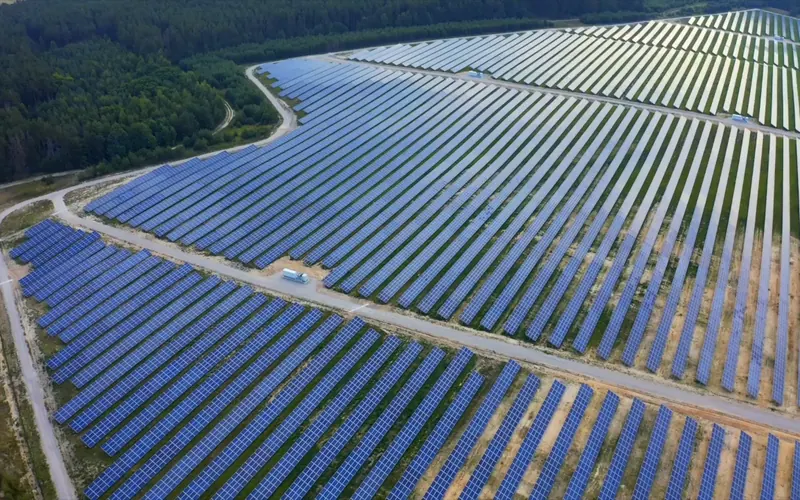
- On-site generation as primary power. A solar plant with battery storage (BESS), sized to the IT load, with grid and gas as backup. On permits, a plant under 0.7 MW is exempt (Electricity Sector Law, art. 19); self-supply of 0.7 MW or more requires a permit and, between 0.7 and 20 MW, may qualify for a simplified procedure (art. 30). Any surplus can only be sold to CFE, and an intermittent plant that injects into the grid must have its own backup or pay for it (art. 32).
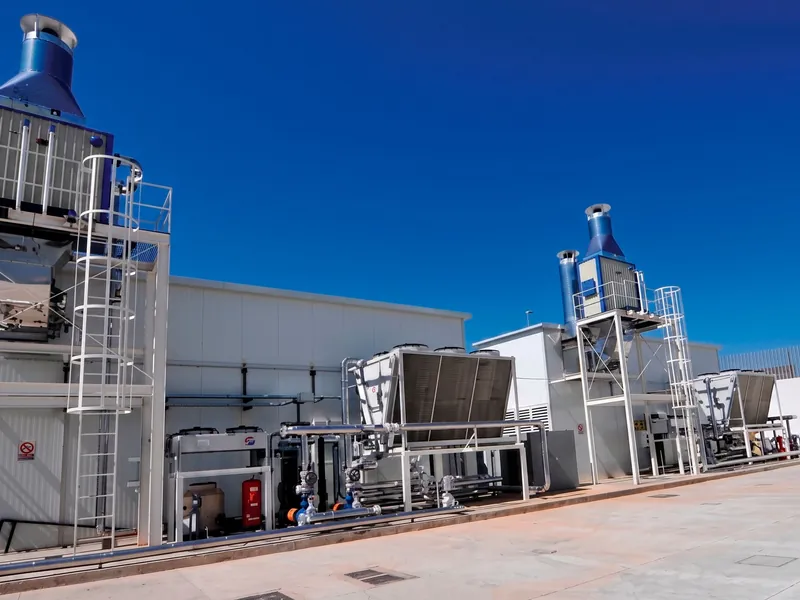
- Bridge power. An on-site plant, gas, solar with BESS or hybrid, that supplies power until interconnection arrives and is designed from the start to stay as backup or as part of the final solution. More on bridge power.
The sequence that usually gives the most room is to request interconnection on day one, start the first stage with on-site power and grow your own generation as the load comes in. A generation permit is not a prerequisite for requesting interconnection studies (art. 49), so both can move in parallel.
Two stages: first the sun covers the day; then more solar and battery cover all 24 hours
How a constant IT load is covered in a Green Data Center, under each option.Illustrative · no figures
Takeaway
Option A is the first, lower-investment stage: the sun covers daytime consumption and the grid or cogeneration covers the night. Option B adds solar and battery to cover all 24 hours.
In both, the grid and firm generation remain as backup. The actual mix comes from each site’s feasibility study, with an 8,760-hour balance.
Illustrative profiles, not to scale. Not a specific project.
Green Data Center: two options for the same load
Green Data Center by GIS Power starts from a 1 MW IT-load module that repeats to grow in stages. At a design PUE of 1.25, each module draws 1.25 MW in total, about 10.95 GWh a year (1.25 MW × 8,760 hours). It takes 1,200 to 1,800 m² of building area and is designed to TIA-942 Rated-3 intent.
On top of that module there are two power options:
| Per MW of IT | Option A · first stage | Option B · 24 hours |
|---|---|---|
| What it covers | Daytime consumption; at night, the grid or cogeneration | Full 24-hour consumption from solar and battery |
| Solar generation | 6.5–7.0 MWp | 6.5–7.5 MWp |
| Battery (BESS) | 5–10 MWh | 22–28 MWh |
| Land for the solar plant | Depends on the site | 10–14 ha |
| Investment | Lower | Higher |
Option A is the first, lower-investment stage: the sun covers daytime consumption and, at night, the load is taken from the grid or from cogeneration. Option B adds solar and, above all, battery, 22 to 28 MWh per MW of IT instead of 5 to 10 MWh, to cover all 24 hours; in exchange, it needs 10 to 14 hectares of PV per MW of IT. In both, the grid and firm generation remain as backup for weather and maintenance, and mission-critical redundancy (UPS and emergency generation) is independent of primary power.
One possible path is to start with Option A and move toward Option B as the load grows and land is secured. These are parameters from a preliminary design concept: each project is sized in its feasibility study. The plant is financed and operated by a project company (SPV), and the data center operator pays for energy or for the service; the schemes are set out in contracting models.
The precedent: Alestra, Querétaro, 2014
The group has already solved this problem in Querétaro. In 2013–2014 it designed and built for Alestra the first data center with cogeneration in Mexico: a 35,000 m² modular data center and a 4.2 MW plant with two GE Jenbacher engines and two 350-ton absorption chillers. The plant supplied 100% of the data center’s power and chilled water, with documented savings of 45% in energy cost. The project was completed in June 2014 and received the “Innovation in the Mega Data Center” award from DC Dynamics.
The lesson holds: when power is designed together with the building, it stops being a date you wait for and becomes part of the construction program. What changes today is primary power: solar and BESS, with gas where there is cooling demand or firmness is needed. The full project sheet is at Alestra Green Data Center, and the case in this article.
What to ask of a feasibility study
Before committing land, equipment or a power contract, the feasibility study should answer with data, not averages. These are the deliverables worth requiring:
- An 8,760-hour balance. The IT load hour by hour, with its staged growth, against solar output, battery charge and discharge, and contributions from the grid or gas. An annual average hides exactly what matters: nights, cloudy weeks and cooling peaks.
- A P50/P90 solar study. P50 is the expected output; P90 is the output exceeded with 90% probability. Battery and backup are sized against the P90 case, not the P50.
- Battery dispatch. When it charges, when it discharges, what reserve is held for transients and how its capacity changes with cycling over the contract term.
- Interconnection route. What capacity is requested, which CENACE studies apply, what reinforcement works may result and who pays for them (arts. 48 and 49). With dates, not just procedures.
- Legal figure and permits. Whether the project is distributed generation, self-supply or generation for the wholesale market, and which permit it needs from the CNE given its capacity. More in permitting and development.
- Land and scheme. Area available for the solar plant and the contracting model: who invests, who owns the plant and what the operator pays.
When on-site generation is not the right fit
- If the substation has confirmed capacity and interconnection arrives before the IT load.
- If the site has no land or roof for the solar plant the load requires, and no nearby land.
- If the IT load is small and stable and the site’s grid connection already covers it comfortably.
- If you need power in weeks: then the conversation starts with bridge power, not with a permitted solar plant.
If you already have a site in Querétaro or elsewhere in Mexico, the conversation starts with three facts: location, expected IT load per stage and the date you need it. That shows which route closes. More on the sector in data centers.
Sources
- Group project history: Alestra Green Data Center (PMI International and GIS Power track records).
- Electricity Sector Law (Ley del Sector Eléctrico), DOF March 18, 2025, arts. 19, 30, 32, 48 and 49.
- SENER, Electricity Sector Development Plan (PLADESE) 2025–2040, DOF October 17, 2025, section 3.
- International Energy Agency, Energy and AI (2025).
- Green Data Center by GIS Power: preliminary design concept for the 1 MW IT module.
Does your data center have a date and the grid does not?
Location, IT load and stage: we will tell you which route closes and what to ask of the feasibility study.
By sending you accept our privacy notice.