
Insights · Efficiency
Energy savings for plant managers: 12 strategies
In many plants, energy is one of the largest costs after payroll and raw materials, and part of it can be cut with technology available today. This guide ranks twelve strategies by ease of implementation and impact, so you can decide where to start.
Originally published on · Updated on
Before you invest: measure
No strategy works without a prior assessment. Before investing, answer three questions:
- How much energy does your plant use, and which processes concentrate the spend?
- What is your demand profile: peak hours, base load, thermal versus electric consumption?
- What is your effective cost per kWh, including demand and power-factor charges?
In most plants, a few pieces of equipment account for most of the consumption. A common mistake is to start with lighting when the waste is in steam, compressed air or refrigeration.
The 12 strategies
1. Energy culture program
Metrics by area, targets and training. It needs no new equipment and prepares the organization for every other measure. It applies to all plants, especially those with high operator turnover.
2. Real-time energy monitoring
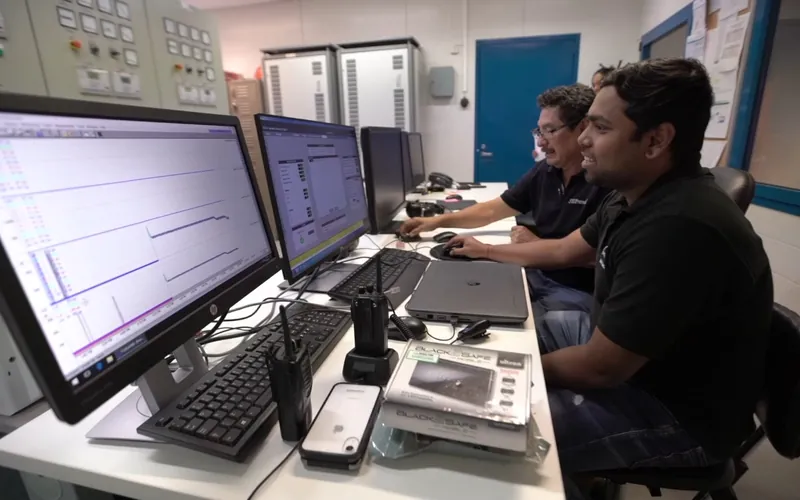
A SCADA or sub-metering system reveals abnormal consumption and failing equipment, and measures the effect of each measure. What is not measured cannot be improved.
3. Power-factor correction
A low power factor triggers charges on the CFE bill. Capacitor banks correct it and are usually among the fastest-payback investments. It applies to plants with motors, compressors and other inductive loads.
4. Compressed-air leaks and pressure
Compressed air is one of the most expensive utilities in a plant. A leak-detection campaign and setting distribution pressure to what the process actually needs reduce compressor work.
5. LED lighting with sensors
The most common entry measure and the most visible, although its share of total consumption is usually moderate. Prioritize large-area buildings.
6. Variable-frequency drives
Many motors run at fixed speed even when the process does not need full capacity. In pumps and fans, power varies roughly with the cube of speed, so a moderate speed reduction cuts consumption sharply. It applies to pumps, fans, compressors and conveyors with variable load.
7. Steam system
Failed steam traps, excessive blowdown, uninsulated piping and unrecovered condensate are constant losses. A trap audit, condensate recovery and automatic blowdown control address the largest ones.
8. Thermal insulation
Uninsulated hot surfaces lose heat around the clock. It applies to plants with boilers, furnaces, autoclaves or steam and hot-water networks.
9. Peak demand management
Under CFE time-of-use tariffs (such as GDMTH), maximum demand recorded during peak hours weighs on the bill even if it lasts minutes. A load-control system, or storage that shaves those peaks, keeps you below the threshold. See hybrid and BESS.
10. Efficient refrigeration
In food, beverages, pharma, hospitals and hotels, refrigeration is a large line item. More efficient chillers, setpoint adjustments and cold-room insulation are high-impact measures. Where heat is available, absorption chillers produce cooling from that heat instead of electricity (trigeneration).
11. Process heat recovery
Heat from exhaust gases, cooling water or hot product can be recovered with heat exchangers and used for preheating, drying or space conditioning.
12. On-site generation: solar, storage and cogeneration
The strategy with the largest absolute impact and the largest investment. Solar with storage reduces the energy you buy from the grid; cogeneration produces electricity and useful heat from a single fuel, with efficiencies of up to 85%, and fits where there is thermal demand and two- or three-shift operation. It can be contracted without committing the full capital; see contracting models.
How to prioritize
- Immediately, with no equipment spend: energy culture and fixing the anomalies monitoring reveals.
- Short term: power factor, compressed-air leaks and lighting.
- Medium term: variable-frequency drives, condensate recovery and insulation.
- Strategic impact: on-site generation, plant-wide monitoring and demand management.
Quick plant check
Each “yes” points to an opportunity you are not using:
- Does your CFE bill include power-factor or maximum-demand charges?
- Does your plant run two or three shifts?
- Do you have processes that use steam, hot water or refrigeration?
- Do your motors run at constant speed even when load varies?
- Has your compressed-air network gone without a recent leak audit?
- Do you lack real-time visibility of each area’s consumption?
- Is energy one of your largest cost items?
With several “yes” answers, a formal energy assessment is justified.
Where GIS Power fits
GIS Power does not sell standalone equipment. We develop, finance, build and operate large-scale generation: solar with storage as primary power, and cogeneration where thermal demand justifies it. The group has developed 56+ MW of cogeneration in Mexico; see the projects and energy-intensive industry.
Sources
- Group project history (cogeneration developed in Mexico and efficiency of up to 85%).
- CFE tariffs: CFE’s current tariff schedule.
Where should your plant start?
Tell us your demand, shifts and thermal load and we will tell you which strategy matters most in your case.
By sending you accept our privacy notice.