
Insights · Data centers
Cogeneration for data centers: a technical guide for infrastructure leaders
Designing power for a data center is nothing like electrifying an industrial plant: the load cannot be interrupted, and almost all the electricity that goes in comes out as heat. This guide summarizes the criteria for on-site generation at a data center: redundancy, cooling, efficiency and operations.
Originally published on · Updated on
Two loads that grow together
A data center uses electricity for compute and energy to remove the heat that compute produces. AI made that relationship critical: a rack such as the NVIDIA GB200 NVL72 connects 72 Blackwell GPUs and 36 Grace CPUs in a liquid-cooled design, at power densities that did not exist a few years ago.
According to the International Energy Agency (IEA), cooling ranges from about 7% of electricity use in an efficient hyperscale data center to over 30% in less efficient enterprise data centers. That range is the opportunity: producing cooling from heat instead of electricity.
From cogeneration to trigeneration
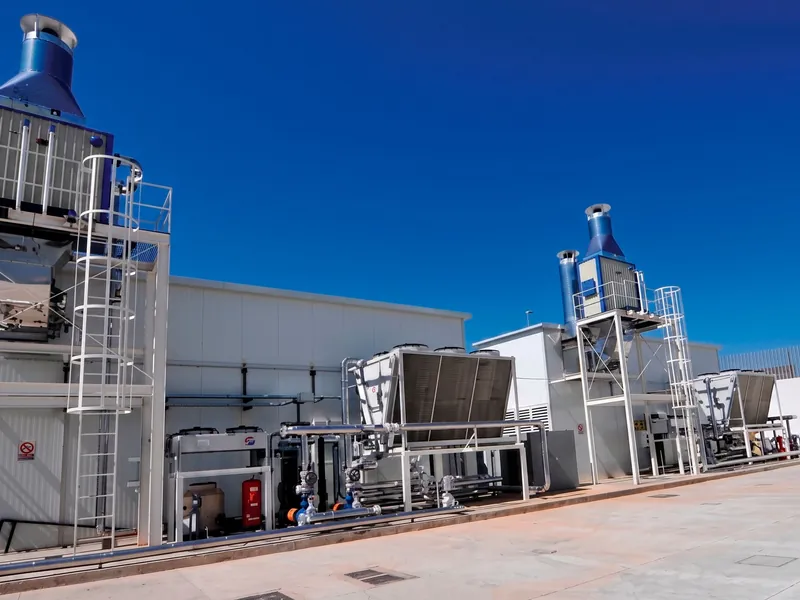
Cogeneration produces electricity and useful heat from a single fuel. In a data center, that heat is used for cooling rather than steam: absorption chillers turn the heat from the engines’ exhaust and jacket water into chilled water. The result is trigeneration: electricity for the IT load and chilled water for cooling, with overall efficiency of up to 85%.
Redundancy: N, N+1 and 2N
- N: just enough capacity for the load, with no backup. Not acceptable for mission-critical use.
- N+1: one unit beyond those required. Allows maintenance without losing load.
- 2N: a fully duplicated system. Maximum availability and the highest investment.
The right question is not how many MW you need, but how many you need if one unit is in maintenance and another fails at the same time. That is the difference between sizing for the load and sizing for the availability contract. In practice, redundant on-site generation is complemented by the grid as an additional source, UPS for transfer and, increasingly, BESS to absorb load swings.
Why PUE matters
PUE (Power Usage Effectiveness) is total data center energy divided by the energy that reaches IT equipment. The theoretical ideal is 1.0; anything above it is auxiliary consumption, mostly cooling. When cooling comes from recovered heat instead of electricity, that auxiliary consumption falls.
Platforms
- Solar with storage (BESS): primary power in the Green Data Center by GIS Power model, with grid and gas as backup.
- Natural-gas engines: modular blocks that allow phased growth and N+1. GIS Power works with INNIO Jenbacher and Guascor, commercial partners with brand-use authorization.
- Absorption chillers: turn engine heat into chilled water.
- Emergency generation: plants used only during emergencies or interruptions need no generation permit (Electricity Sector Law, art. 19).
If the site has no interconnection yet, generation can start as bridge power and remain as backup once the grid arrives.
From design to operations
- Feasibility study and load-profile analysis.
- Basic and detailed engineering integrated with the electrical and cooling infrastructure.
- CNE permits and, if grid-connected, CENACE studies (see grid interconnection).
- Construction: civil works, engine erection, heat recovery, switchgear and controls.
- Commissioning and acceptance testing.
- Contracted operations and maintenance with round-the-clock response.
The precedent in Mexico
In 2013–2014 the group designed and built the first data center with cogeneration in Mexico for Alestra in Querétaro: a 35,000 m² modular data center with a 4.2 MW plant, two GE Jenbacher engines and two 350-ton absorption chillers, supplying 100% of its power and chilled water. Documented energy-cost savings were 45%. See the Alestra case.
The group’s mission-critical track record goes further back: data centers for GTE in Tampa, Fort Wayne, Sacramento and Mexico, Telemar in Brazil and Terminal 2 of Mexico City’s airport. More in critical power.
When it is not a fit
- A small data center where the grid already provides the capacity and reliability it needs.
- No gas at the site: trigeneration does not apply, although solar with BESS can.
Sources
- International Energy Agency, Energy and AI (2025): cooling share of data center consumption.
- NVIDIA: GB200 NVL72 specifications.
- Electricity Sector Law, DOF March 18, 2025, art. 19.
- Group project history: Alestra Green Data Center and ESI and PMI mission-critical projects.
Sizing power for a data center?
IT load, target redundancy and location: with that we prepare a feasibility study.
By sending you accept our privacy notice.